loader
Precision medicine for DCIS
DCISionRT by PreludeDx

Welcome to a New Paradigm
for DCIS Management

Biology-based insight into recurrence risk and radiation benefit after breast-conserving surgery.

For patients and their treating physicians
01 / A new paradigm

Predicts radiation benefit.

DCISionRT is the only test capable of predicting an individual patient’s benefit from radiation therapy. Using DCISionRT provides you with 10-year Total and Invasive Recurrence Risk after breast conserving surgery as well as surgery with radiation therapy. No other test can do this.

Enables precision medicine.

DCISionRT provides you the information to deliver precision medicine to your patients. Unlike grade, tumor size or patient age, DCISionRT quantifies a woman’s risk based on her DCIS biology. Studies have shown that DCISionRT reclassifies over 50% of patients compared to grade and size[REF CCR]. The future of DCIS management is here with DCISionRT.

Unmatched clinical evidence.

DCISionRT has undergone multiple independent validations, including the landmark SweDCIS randomized clinical trial. The test has the highest dynamic range and most consistent results study to study. Evidence includes over 2000 patients from development through validation. No other DCIS test is supported by published Level 1b clinical evidence.

DCISionRT provides physicians with the first radio-genomics tool to predict radiation therapy benefit.

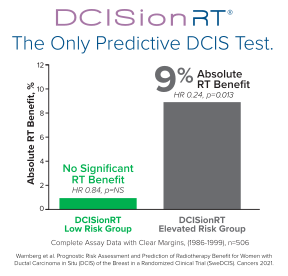
In an independent clinical validation of DCISionRT in the landmark SweDCIS randomized clinical trial, patients with low Decision Scores no significant invasive risk reduction from radiation therapy after surgery whereas patients with elevated Decision Scores had a 9% reduction in invasive risk (HR 0.24, p=0.012). This study, for the first time, demonstrates a DCIS test that predicts the extent to which patients benefit from radiation therapy.

SweDCIS: 10-year invasive recurrence risk by Decision Score and treatment
SweDCIS: 10-year invasive recurrence risk by Decision Score and treatment Open full-size chart ↗
02 / Precision medicine

DCISionRT enables physicians to deliver precision medicine to DCIS patients

53%Low / intermediate grade reclassified as elevated risk
30%High grade identified as low risk
474Patients in the multisite study
In a multisite study including 474 DCIS patients, DCISionRT substantially reclassified DCIS patient risk compared to traditional clinicopathologic risk assessment, such as grade (shown). In fact, 53% of patients with low or intermediate grade DCIS (grade 1 or 2) were upstaged to elevated risk by DCISionRT and 30% of patients with high grade DCIS (grade 3) were identified as low risk by DCISionRT1. With DCISionRT, patients and physicians have access to a test that enables truly personalized treatment based on a patient’s individual biology.
Traditional risk assessment using DCIS grade to DCISionRT risk groups indicates the power of the DCISionScore. While traditional risk assessment with DCIS grade shows little difference for low/intermediate grade DCIS (grade 1 & 2) compared to high grade DCIS, DCISionRT distinguishes which patients have a clinically low risk (DCISionScore ≤3) from those with clinically elevated risk (DCISionScore >3). With DCISionRT, Know Your Risk™.

Results are shown are for the 196 patients treated with conserving surgery treated patients with clear margins in a multisite study. Total recurrence risks shown are adjusted for year of diagnosis. This was demonstrated in a multisite study of 474 patients1.

1 Bremer T, Whitworth P, Patel R, et al. . A biologic signature for breast ductal carcinoma in situ to predict radiation therapy (RT) benefit and assess recurrence risk. Clin Cancer Res . 2018; doi:10.1158/1078-0432.CCR-18-0842.


03 / Physician perspectives

Hear what physicians are saying about DCISionRT

Radiation oncologists discuss DCISionRT

Surgeons discuss DCISionRT

04 / Understanding the report

What information does DCISionRT give me?

Based on the biology of your DCIS, the DCISionRT test provides you and your physician the information needed to make a decision whether surgery alone or surgery with radiation therapy is appropriate.

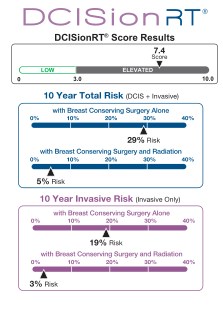
DCISionRT® Score Results

DCISionRT provides a woman’s individual DCISionScore on a scale from zero to ten, which corresponds to recurrence risks.

DCISionRT® Score Results — example report, not an individual patient result
DCISionRT® Score Results — example report, not an individual patient result Open full-size chart ↗

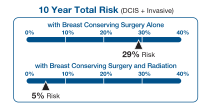
10 Year Total Risk

Total risk is the chance of having either a DCIS recurrence or developing invasive breast cancer within 10-years.

10 Year Total Risk — example report, not an individual patient result
10 Year Total Risk — example report, not an individual patient result Open full-size chart ↗

10 Year Invasive Risk

Invasive risk is the probability of developing invasive breast cancer in the breast originally diagnosed with DCIS within 10-years.

10 Year Invasive Risk — example report, not an individual patient result
10 Year Invasive Risk — example report, not an individual patient result Open full-size chart ↗
05 / Residual Risk Subtype

What Is the Residual Risk Subtype

The Residual Risk Subtype (RRt) is a distinct molecular subtype identified by DCISionRT®. It represents patients with elevated recurrence risk after breast-conserving surgery (BCS) that is driven by the tumor’s underlying biology—not just traditional clinical factors.

DCISionRT generates a continuous Decision Score (0–10).

Different score ranges correspond to biologically distinct subtypes and levels of recurrence risk.

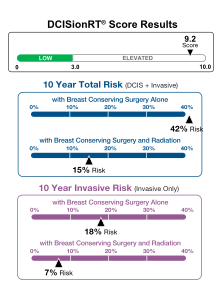
  • A Decision Score of 9.2 uniquely defines the Residual Risk Subtype.
  • 1 out of 5 DCIS patients are Residual Risk

A 9.2 Decision Score indicates:

  • High residual biological risk after surgery
  • Substantial likelihood of recurrence over 10 years without radiation
  • Radiation therapy meaningfully reduces risk
  • However, risk may remain elevated even after BCS + RT

Importantly, not all elevated scores represent RRt. Many elevated-risk patients derive substantial benefit from radiation and achieve strong risk reduction. RRt specifically identifies a unique group whose tumor biology may warrant broader treatment discussion.

The Residual Risk Subtype enables clinicians to align treatment intensity with tumor behavior, personalize adjuvant therapy recommendations, and support informed, shared decision-making with patients.

Residual Risk Subtype: Decision Score 9.2
Residual Risk Subtype: Decision Score 9.2 Open full-size chart ↗
06 / Case studies

Case Studies

The DCISionRT® test indicates your individual risk of recurrence and expected benefit from radiation therapy.

Example 1

Age: 51 years  |  DCIS Grade: Intermediate (Grade 2)  |  DCIS size: 30mm

Before DCISionRT

Risk Assessment
Traditional Clinpath Features

TREATMENT PLAN:
Surgery with radiation therapy

TREATMENT RATIONALE:
Radiation therapy after breast conserving surgery is recommended based on age, grade and size.

Example 1: DCISionRT risk assessment
Example 1: DCISionRT risk assessment Open full-size chart ↗

After DCISionRT

Risk Assessment

TREATMENT PLAN:
Breast conserving surgery

TREATMENT RATIONALE:
Because the patient has a Low DCISionRT score, the Physician and patient decide to defer radiation therapy and elect breast conserving surgery.

Example 2

Age: 45 years  |  DCIS Grade: Low (Grade 1)  |  DCIS size: 10mm

Before DCISionRT

Risk Assessment
Traditional Clinpath Features

TREATMENT PLAN:
Breast conserving surgery

TREATMENT RATIONALE:
Traditional risk assessment using clinicopathologic features indicates patient could be considered “low risk” and therefore, the patient and physician elect to forego radiation therapy.

Example 2: DCISionRT risk assessment
Example 2: DCISionRT risk assessment Open full-size chart ↗

After DCISionRT

Risk Assessment

TREATMENT PLAN:
Surgery with radiation therapy

TREATMENT RATIONALE:
New information from DCISionRT indicates the patient is at Elevated Risk if treated with surgery alone. The patient and physician decide to use radiation therapy-–despite traditionally low risk clinicopathalogic features—due to the large risk reduction from radiation therapy.

07 / Ordering information

Ordering Information

The following ordering, insurance, USD pricing and turnaround details describe PreludeDx’s US service. Contact our team to confirm local arrangements.

Start patient form
Eligibility Requirements
  • Female, age 30 – 85
  • Diagnosed with ductal carcinoma in situ (DCIS) of the breast
  • Treated with breast conserving surgery or had a core biopsy
    • Max tissue sample size for surgery – 60 mm (6.0 cm)
    • Max tissue sample size for biopsy – 15 mm (1.5 cm)
  • Minimum tissue required is 1 mm of DCIS or 2 ducts with DCIS
  • Any nuclear grade is acceptable: Grade 1 (low), Grade 2 (intermediate) or Grade 3 (high)
  • ER+, ER-, PR+, PR- patients are acceptable
How to Order
  • Fill out a DCISionRT test requisition form
  • Fax the following information to PreludeDx Customer Care at 1.888.909.3247
    • Completed test requisition form
    • Pathology report
    • Medical/physician notes
    • Insurance card (front and back)
  • Customer Care will request the tissue specimen as indicated on the test requisition
Insurance
  • PreludeDx currently accepts all insurance plans
  • DCISIonRT list price is $6,595 (PLA Code 0295U)
  • Financial assistance may be available for patients meeting certain requirements
  • Contact our Patient Care Team at 888.211.3247 or email billing@preludedx.com for more information.
Receiving Results
  • For initial first-time orders, please allow additional 1-2 days for pathology to arrive at our location.
  • DCISionRT results are typically available within 3-5 days from receiving the tissue specimen
  • Results will be provided via fax, encrypted email or physician portal
Explanation of DCISionRT Results:
DCISionRT gives patients:

  1. Their overall score (continuous risk score and low vs elevated category)
  2. Their rate of recurrence over 10-years
  3. Their benefit of radiation