PET/CT ambiguity
PET/CT remains central to response assessment, but false-positive findings may create uncertainty at the end of treatment.


Medical Tests
Signatera™ for clinicians
Signatera™ is a personalized, tumor-informed ctDNA assay that may help address key challenges in diffuse large B-cell lymphoma by detecting molecular residual disease, tracking response, and helping clarify relapse risk when PET/CT findings are difficult to interpret.

Clinical challenge
For lymphoma care teams, assessment decisions can be complicated by imaging limitations, treatment-related changes, and the practical limits of repeat tissue biopsy.
PET/CT remains central to response assessment, but false-positive findings may create uncertainty at the end of treatment.
Tissue biopsy is not always feasible, especially when patients need timely treatment planning or surveillance decisions.
ctDNA-positivity may help identify patients at elevated risk, supporting more informed follow-up conversations.
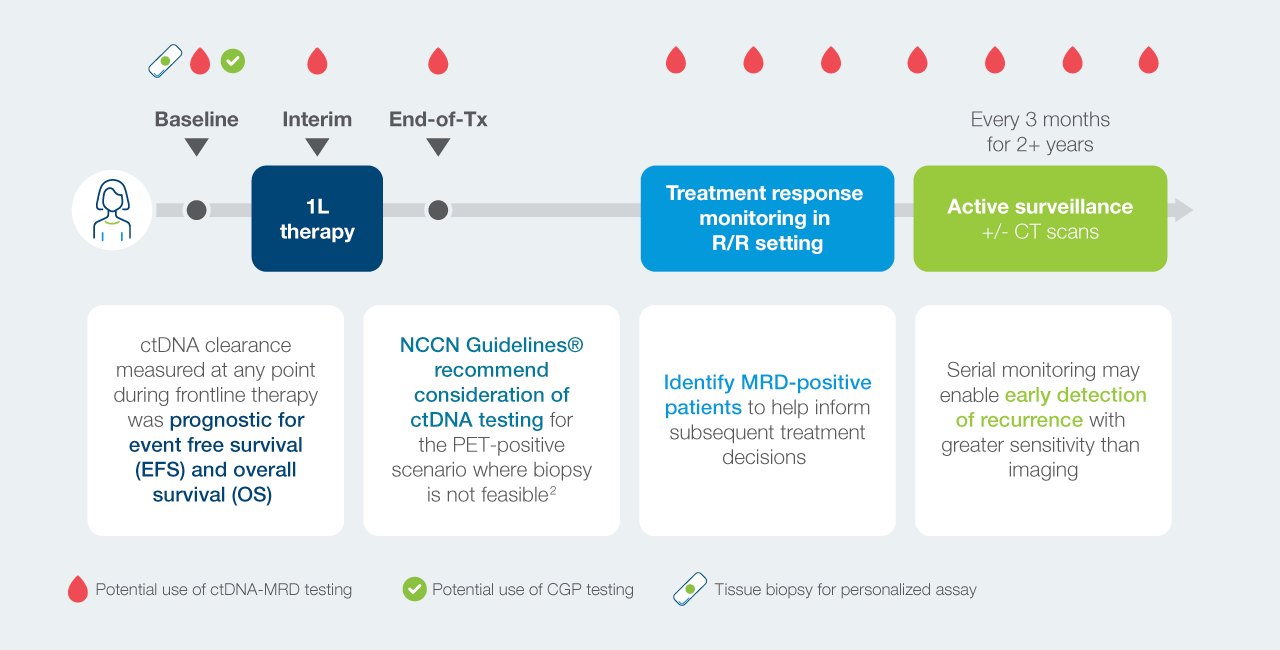
Across the journey
Evidence overview
This study analyzed prospectively collected, real-world data of MRD detection and ctDNA clearance kinetics in patients with either newly diagnosed or relapsed/refractory lymphoma across 14 subtypes, including a subset of patients who received CAR-T cell therapy.
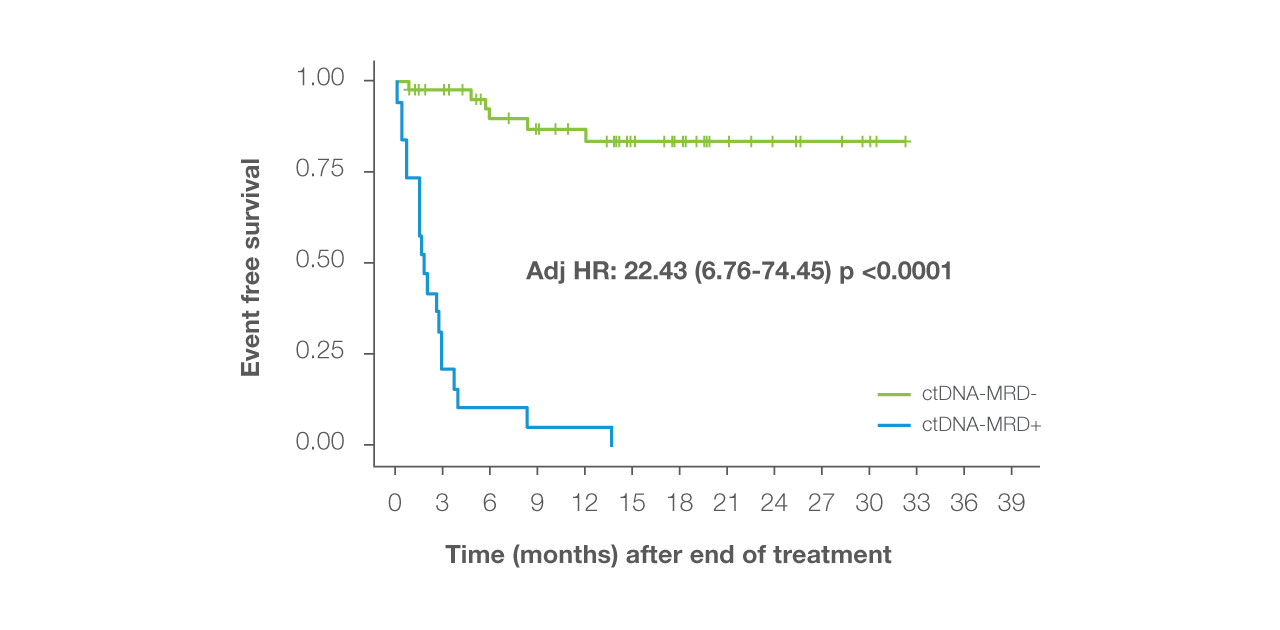
ctDNA-positivity at EOT identifies a nearly 50x increased risk1 of an EFS event.
Signatera™ achieves 100% positive predictive value (PPV) for EFS event at end of treatment.1
In a previous real-world study, Signatera™ demonstrated 89% sensitivity and 94% specificity for MRD detection in patients with DLBCL.3
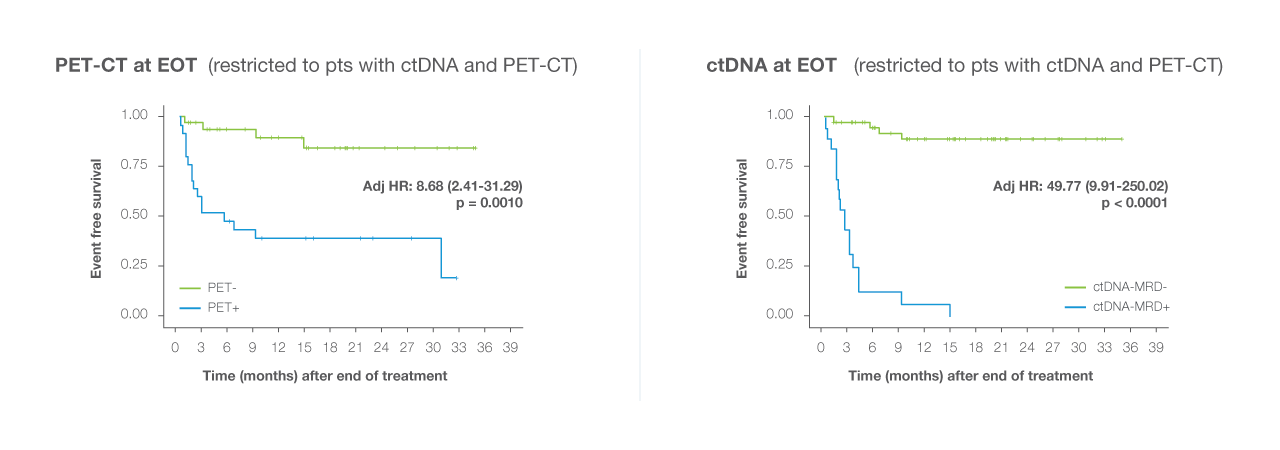
When imaging results are PET-positive at the end of treatment and biopsy is not feasible, ctDNA-MRD assessment may provide an additional layer of evidence for care teams.

Clinical guidelines
NCCN Guidelines® recommends consideration of ctDNA testing for resolving PET-positive EOT results in DLBCL, when biopsy is not feasible.2
NCCN = National Comprehensive Cancer Network®. NCCN makes no warranties of any kind whatsoever regarding their content, use, or application and disclaims any responsibility for their application or use in any way.
Where it may help
Support follow-up planning when residual molecular signal is detected after treatment.
Monitor ctDNA clearance kinetics alongside clinical assessment and imaging.
Help identify molecular relapse earlier so teams can evaluate next steps.
Give patients and providers a clearer testing pathway through Advance Medilinks.
Advance Medilinks support
Our team can support test access, coordination, logistics guidance, and patient communication for advanced cancer genomics.

Signatera™ is transforming the management of cancer with personalized testing. Signatera™ is a personalized tumor-informed assay optimised to detect ultra-sensitive circulating tumour DNA (ctDNA) for molecular residual disease...
Patient Form© Copyright 2022 - 26 | All Rights Reserved.