loader

Medical Tests

Signatera™

Personalized MRD Testing

Transforming the management of cancer with personalized testing

As pioneers and trusted leaders in the MRD testing space, Signatera™ has been characterized in >170 peer-reviewed publications and with now >300K patients tested. With this unrivaled clinical validation and real-world experience, clinicians can feel confident with the accuracy and reliability of a Signatera™ result.

>170peer-reviewed publications
>300Kpatients tested

Clinical Applications

Signatera™ Indications

Signatera™ can be used for a variety of cancer types.

Gastrointestinal Cancer

Signatera™ is custom-built to your unique set of tumor mutations to predict colorectal cancer recurrence. Because it is highly sensitive it can detect very small traces of tumor in the body so the oncologist can know earlier if cancer is present and make more informed decisions regarding the treatment.

Signatera™ is covered by Medicare (U.S.A.) for Stage II-IV and oligometastatic colorectal cancer (CRC) in the adjuvant and recurrence monitoring settings.

Bladder Cancer

Personalized molecular residual disease (MRD) testing in bladder cancer.

Signatera™ is covered by Medicare U.S.A. for muscle invasive bladder cancer (MIBC) in the adjuvant and recurrence monitoring settings.

Lymphoma

Signatera™ can be used to help better manage your patient’s lymphoma with a more personalized approach to their care including assessing MRD status after completion of initial therapy to help predict relapse and identifying patients who are MRD-positive to inform additional treatments.

Stay Informed

Sign up for the Newsletter on Signatera™

Receive updates and educational information about personalized molecular residual disease testing.

Understanding MRD

Why circulating tumor DNA (ctDNA) for molecular residual disease assay (MRD) assessment?

ctDNA is a powerful tool that can be measured to assess the absence or presence of MRD.

Signatera™ is a highly sensitive and personalized MRD assay using ctDNA and is custom designed for each patient to help identify relapse earlier than standard of care tools.

Illustration showing tumor-specific mutations, ctDNA in a blood sample, and monitoring of mean tumor molecules after treatment

Across the Cancer Journey

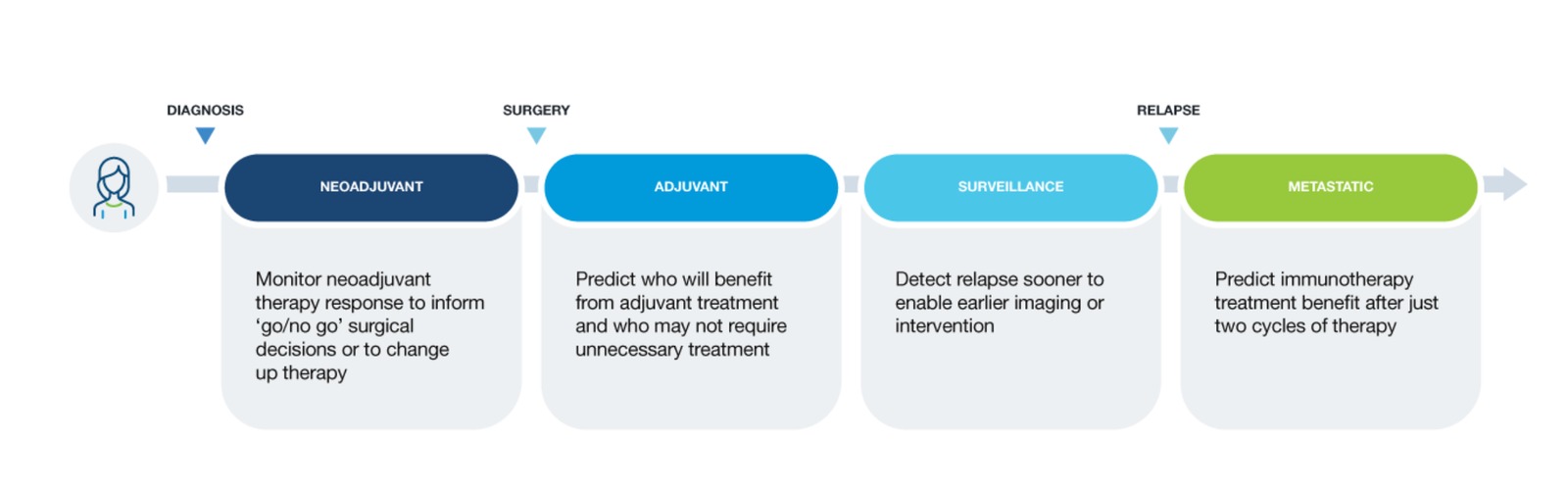
Clinical applications of ctDNA testing for MRD assessment

Clinical applications of ctDNA testing from diagnosis through neoadjuvant, adjuvant, surveillance, and metastatic settings

Clinical Evidence

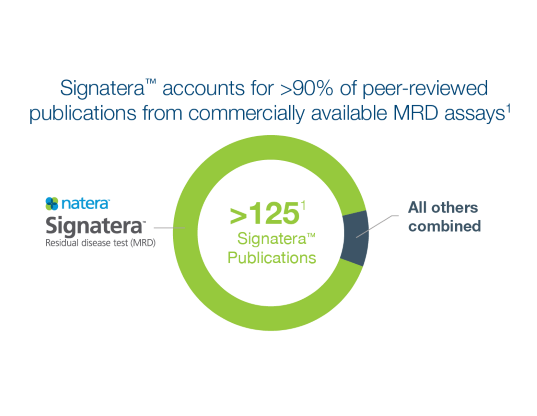
Not all MRD tests are created equal

Signatera™ is the most comprehensive MRD test available. Review our peer-reviewed publications here.

Chart showing Signatera accounts for more than 90 percent of peer-reviewed publications from commercially available MRD assays

Validated Performance

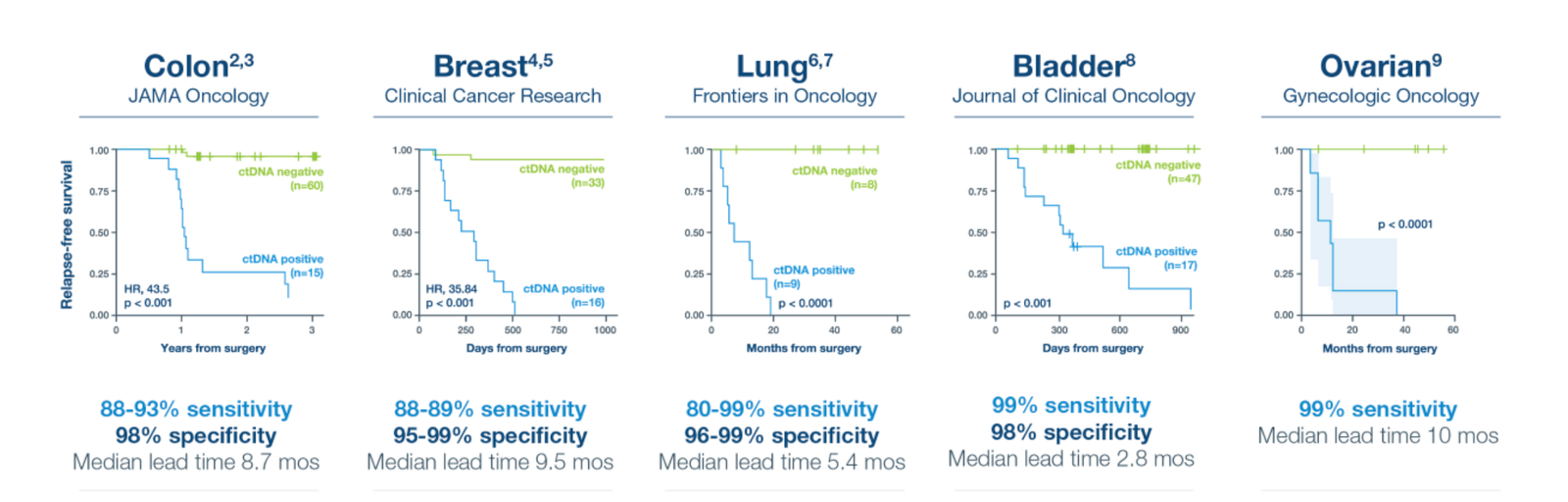
A positive Signatera™ result predicts relapse with overall positive predictive value more than 98%1-8

In clinical studies, Signatera showed high performance across multiple solid tumors.

Clinical study performance of Signatera across colon, breast, lung, bladder, and ovarian cancers

Truly Individualized

Signatera™ is the first tumor-specific assay for truly individualized cancer care

Personalized design for every patient

  • Custom-built assay—based on the unique mutation signature of each patient’s tumor—identifies and tracks tumor mutations at the source.
  • Once a personalized assay is designed, a patient’s blood can be used to accurately monitor for the presence or absence of the disease over time.

How It Works

A personalized and tumor-informed approach to MRD surveillance

01

Personalized, tumor-informed assay

One-time, primary tissue sample and matched normal sample is required for whole exome sequencing and personalized test design.

02

Optimized for longitudinal monitoring

Once the patient’s personalized test has been designed, only a blood sample is needed each subsequent time.

03

Ultrasensitive ctDNA detection

Signatera™ is designed to detect ctDNA of somatic and truncal variants to optimize sensitivity. Tumor-informed method enables filtering of CHIP mutations to decrease false positive rates.

Coverage

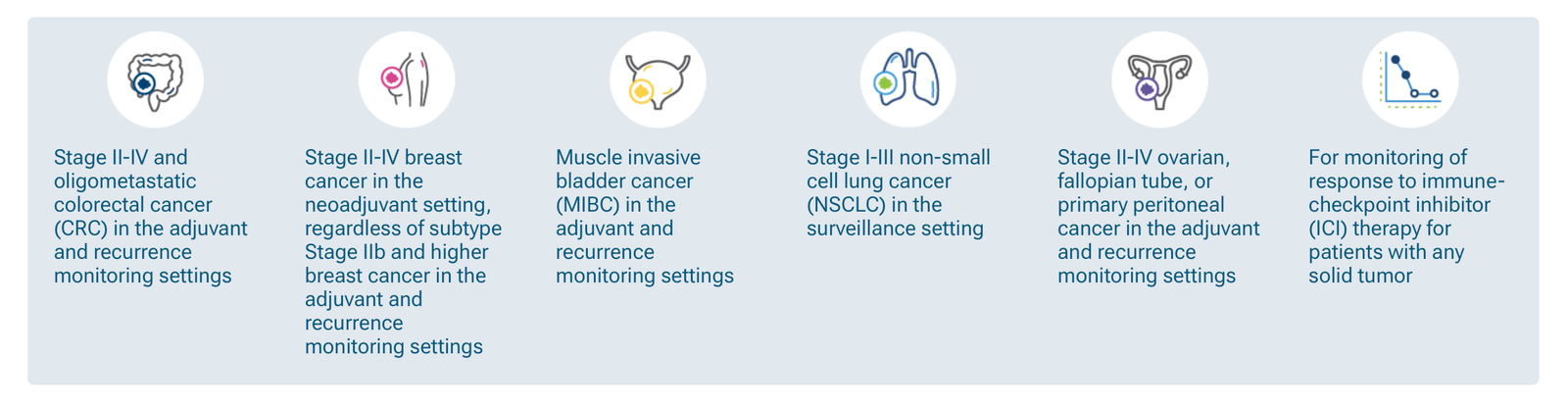
Covered by Medicare U.S.A. for multiple solid tumor indications

Medicare coverage indications for colorectal, breast, bladder, lung, ovarian, and solid tumors

Questions, Answered

FAQ

What is Signatera™ and what does it test for?

Signatera™ is a personalized, tumor-informed assay optimized to detect circulating tumor DNA (ctDNA) for molecular residual disease (MRD) assessment, treatment response monitoring, and early recurrence monitoring.

How is Signatera™ different from current biomarker tests?

Unlike other ctDNA assays, Signatera™ is designed to accurately detect MRD (i.e., not designed for early cancer screening nor for identifying actionable mutations for therapy selection). Instead, Signatera™ is customized for each patient’s unique tumor signature to optimize sensitivity and specificity for accurate MRD assessment.

How accurate is Signatera™?

By only tracking tumor-specific variants, sensitivity is maximized with a low limit of detection (LOD) of 0.01% variant allele frequency (VAF). Also, Signatera™ filters out clonal hematopoiesis of indeterminate potential (CHIP) mutations to greatly reduce false-positive results.

What information does the test report provide?

Signatera™ reports the presence or absence of circulating tumor DNA (ctDNA) and ctDNA quantity in terms of mean tumor molecules per mL (MTM/mL) to allow for assessment of tumor burden over time.

What does a positive Signatera™ result mean?

A positive test result indicates the presence of molecular residual disease (MRD). Serial sampling can be used to track whether disease burden is increasing or decreasing in response to treatment.

What does a negative Signatera™ result mean?

A negative result indicates that molecular residual disease (MRD) was not detected. Serial sampling can be used to track whether disease burden remains undetectable or increases to catch relapse early.

What type of samples are needed for Signatera™?

For initial testing, tumor tissue will need to be provided as a formalin-fixed paraffin-embedded (FFPE) block or on slides. The first blood draw will require one 6 ml EDTA tube and two 10 mL Streck tubes. All subsequent draws will only require two 10 mL Streck tubes.

What is the turnaround time for my Signatera™ results?

Initial test design takes 5-6 weeks after receipt of tumor and blood samples. Subsequent blood draws have a turnaround time of 15 days.

References

  1. Natera Data on File as of July 1st, 2025.
  2. Reinert T, Henriksen TV, Christensen E, et al. JAMA Oncol. 2019.
  3. Kotani D. et al. Nature Medicine v29 Issue 1 Jan 2023.
  4. Coombes RC, Page K, Salari R, et al. Clin Cancer Res. 2019;25(14):4255-4263.
  5. Shaw et al. JCO Precis Oncol 8, e2300456(2024). DOI:10.1200/PO.23.00456.
  6. Lebow, E. et al. Front. Oncol. 2023,13:1253629.
  7. Martin T, Dinerman A, Sudhaman S, et al. J Thorac Cardiovasc Surg. 2024.
  8. Christensen E, Birkenkamp-Demtroder K, Sethi H, et al. J Clin Oncol. 2019;37(18):1547-1557.
  9. Hou JY, et al. Gynecologic Oncology. 2022; 167: 334-341.

Advanced Medilinks Pvt Ltd is an authorized distributor of Natera’s Signatera™ in India. The content has not been reviewed by nor endorsed by Natera, Inc. Advanced Medilinks Pvt Ltd is solely responsible for maintaining content according to Natera partnership guidelines as well as all legal and regulatory requirements in India. CAP accredited, ISO 13485 and CLIA certified. © 2026 Natera, Inc. All Rights Reserved.

Our Services

Signatera™ Initial

Signatera™ Initial

Transforming the management of cancer with personalized testing Signatera™ is a highly sensitive and personalized molecular residual disease assay (MRD) using circulating tumor DNA (ctDNA), custom designed for...

Patient Form